




- HOME
- Proposals/News
- Event/Sminar
- Seminar Report: 13th Session of the International Study Group: An Introduction to the EU AI Act-A Risk-based Approach and Required Corporate Responses
Seminar Report: 13th Session of the International Study Group: An Introduction to the EU AI Act-A Risk-based Approach and Required Corporate Responses
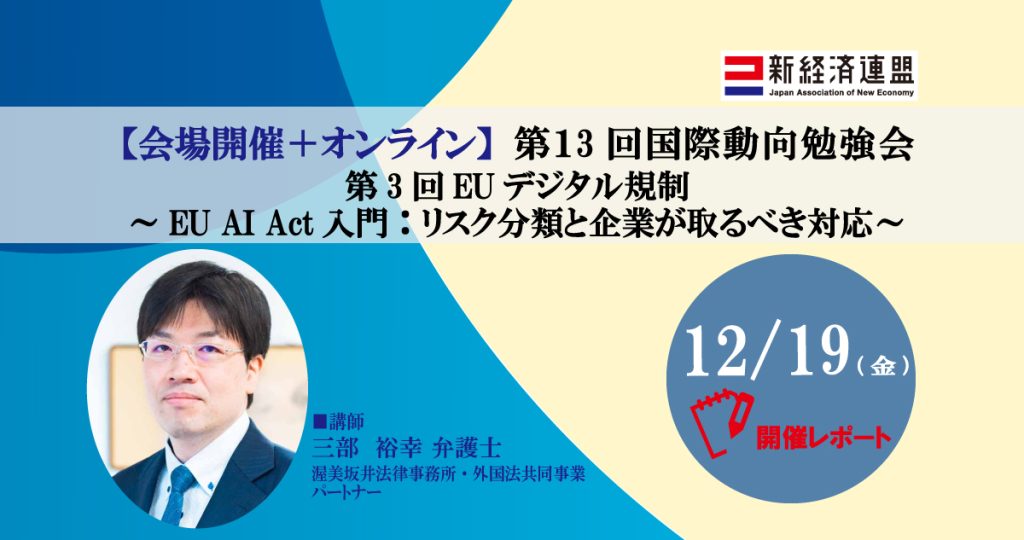
On December 19, the Japan Association of New Economy (JANE) hosted its 13th Session of the International Study Group.
At this session, Mr. Hiroyuki Sanbe, Partner of Atsumi & Sakai; Guest Professor of the Research Center on Ethical, Legal and Social Issues of the University of Osaka, was invited as a guest speaker and provided an overview of the EU AI Act, its practical implications for Japanese companies, and its relationship with non-EU legislation.
At the beginning of the session, he explained the background behind the EU’s pioneering AI regulations from two perspectives: the promotion of business within the single market and the protection of fundamental rights based on historical lessons. He emphasized the importance of a correct understanding of the AI Act, saying that the AI Act is not intended to hinder business or exclude U.S. companies.
He then outlined the “risk-based approach,” which is the core of the AI Act, introduced through its four classifications: “Unacceptable Risk,” “High Risk,” “Limited Risk,” and “Minimal Risk.” He provided detailed explanations with specific examples, particularly regarding unacceptable risk and high-risk AI.
In addition, regarding the practical impact on Japanese companies, he addressed the risks of extraterritorial application. He pointed out that even companies based in Japan may be subject to the AI Act, in which case conformity assessments would be crucial, taking into consideration the situation where the companies may be required to show their compliance during exports or when entering contracts with business partners. Furthermore, he noted that while enforcement of high-risk AI regulations might be delayed due to discussions on “Digital Omnibus”, the underlying requirements and obligations remain stringent, stressing that Japanese companies should begin addressing manageable items early.
Finally, he introduced U.S. AI policy trends at the administration, congressional, and state levels, as well as the federal AI Action Plan. He explained that while this plan focuses on innovation, infrastructure, and international diplomacy and security, it also addresses various AI risks. He pointed out that Japan’s risk-response measures may be insufficient compared to those of the U.S. and EU, concluding that it is critically important for Japan to consider effective risk mitigation strategies in light of these international developments.
A recording of the session and the presentation materials are available on the JANE Members’ Site. All employees of member companies may access the site by creating an account via the “Members’ Site” link on the JANE homepage.
As membership is verified based on corporate domains, please register using the corporate email address provided by your corporation when creating an account. There is no limit on the number of accounts per member company, so each individual may create an account freely.
JANE will continue to host International Study Group Sessions, focusing on timely and significant developments in global laws and regulatory frameworks.
Proposals/News